Fiber Optic Cable Characteristics |
Fiber optic cables consist of multiple strands of optic fibers, hairlike strands of pure glass designed to transmit light. When hundreds or thousands of these strands are put together, they are able to transmit waves of light up to 60 miles. Electrical signals, such as television, voice or data signals, are converted to high-quality optical signals using an optical transmitter and sent at the speed of light, producing a fast, high-quality method of data transmission.
History
The concept of guiding reflected light was demonstrated as early as the 1840s, when French scientists Daniel Colladon and Jacques Babinet were able to transmit light along a stream of liquid, dubbed a "light pipe." Using this principle, fiber optic cable was first commercially developed in the 1970s, revolutionizing the telecommunications industry. Until then, signals had been sent and received using copper strands or satellite systems, which have now largely been replaced by optic fiber technology.
|
|
|
Optic Fiber Structure
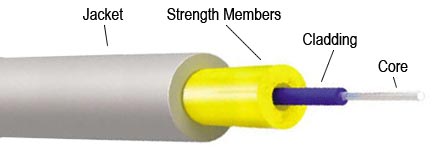
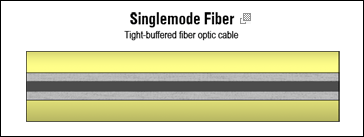
Optical fibers consist of a pure glass core surrounded by multiple layers. The first layer is a reflective cladding, which acts like a long, flexible mirror, reflecting light along the length of the glass core. This principle is known as total internal reflection. Next, an outer protective layer known as a "buffer" coating is applied to shield the fiber from damage and moisture. Bundles of these optical fibers are then enclosed by a strengthening layer of aramid yarn, and finally a plastic "jacket" to create a complete fiber optic cable.
Applications
Fiber optic cables are now used as the predominant form of transmission in communications, cable television and the Internet. The continuous development of Internet technology has only been possible through the use of fiber optics. The latest development is a direct Internet connection, called "fiber to the home" (FTTH), which gives superior speed and connection quality. FTTH services are still only very limited because the cost compared to standard Internet connections is very high.
Advantages
Fiber optic cables provide superior quality transmissions compared to satellite and copper systems. Long distance telecommunications using satellite technology are prone to weak connections and echoing, which are greatly improved when optic fiber is used. Copper cables used for electrical transmission are much larger and heavier, have a much lower bandwidth capacity, are affected by electromagnetic interference and are prone to higher rates of loss over long distances. These problems are virtually eliminated with the use of fiber optic technology. |